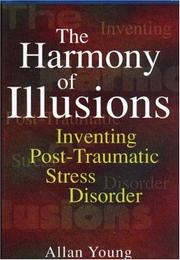
The harmony of illusions
Allan Young · 1995
על הספר
Western ideas about traumatic memory have changed profoundly over the last century. Allan Young argues that the transformation is connected to two other historical changes: the emergence of new conceptions of human nature and consciousness, and the evolution of psychiatry as an autonomous clinical specialty and branch of medical science. Young traces the psychiatric history of traumatic memory from its beginnings - in railway spine, traumatic hysteria, shell-shock, double consciousness, and mental parasites - to its contemporary manifestation, post-traumatic stress disorder (PTSD). In Young's view, PTSD is not a timeless or universal phenomenon, nor is it a discovery. Rather, it is a cultural product: a reality that is glued together by diagnostic technologies, styles of scientific and clinical reasoning, and modes of self-narration and confession. Nor is PTSD simply a psychiatric phenomenon; it is also a moral development: a diagnosis that transgresses the boundary dividing victims from victimizers, and a contagion that crosses the line separating patients from therapists. This book is part history and part ethnography, and it includes a detailed account of everyday life in a psychiatric unit specializing in the diagnosis and treatment of Vietnam War veterans with PTSD. Young argues that PTSD cannot be separated from the routines, technologies, and patterns of thinking through which it is encountered. At the same time, he allows the people in his book - these veterans and their therapists - to speak in their own words, and he vividly evokes the disorder's reality in their lives, as they struggle to make sense of their disturbing memories of a tragic war.
פרטי הספר
- שנה
- 1995
- שפה
- English
- הוצאה
- Princeton University Press
- מהדורות
- 1
- עמודים
- 340
- ISBN
- 9780691017235
מקור הנתונים: Wikidata
עוד של Allan Young