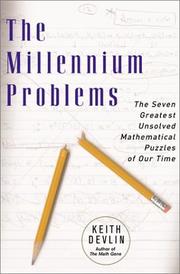
The Millennium Problems
Keith J. Devlin · 2004
איפה לקנות
בדקו את המחיר העדכני באמזון. אנחנו לא מציגים מחירים כי הם משתנים מדי יום.
לצפייה באמזוןקישור שותפים. בתור שותפים של Amazon אנחנו מרוויחים מרכישות מתאימות.
על הספר
In 2000, the Clay Foundation announced a historic competition: whoever could solve any of seven extraordinarily difficult mathematical problems, and have the solution acknowledged as correct by the experts, would receive 1 million in prize money. There was some precedent for doing this: In 1900 the mathematician David Hilbert proposed twenty-three problems that set much of the agenda for mathematics in the twentieth century. The Millennium Problems--chosen by a committee of the leading mathematicians in the world--are likely to acquire similar stature, and their solution (or lack of it) is likely to play a strong role in determining the course of mathematics in the twenty-first century. Keith Devlin, renowned expositor of mathematics and one of the authors of the Clay Institute's official description of the problems, here provides the definitive account for the mathematically interested reader. [Review by David Roberts, on 02/7/2003] In May 2000, the Clay Mathematics Institute elevated seven long-standing open problems in mathematics to the status of "Millennium Prize Problems," endowing each with a million-dollar prize. The seven particular problems were chosen in part because of their difficulty, but even more so because of their central importance to modern mathematics. The problems and the corresponding general areas of mathematics are as follows. 1) The Riemann Hypothesis - Number Theory 2) Yang-Mills Existence and Mass Gap - Mathematical Physics 3) The P versus NP problem - Computer Science 4) Navier-Stokes Existence and Smoothness - Mathematical Physics 5) The Poincaré Conjecture - Topology 6) The Birch and Swinnerton-Dyer Conjecture - Number Theory 7) The Hodge Conjecture - Algebraic Geometry The Navier-Stokes equations were first written down in the early 1820's, Riemann made his hypothesis in an 1859 paper, and the Poincaré conjecture dates from 1904. The remaining problems arose in the period 1950-1971. In The Millennium Problems, Keith Devlin aims to communicate the essence of these seven problems to a broad readership. It is, of course, a very ambitious goal. The preface makes it clear what Devlin's ground rules are. First he assumes only "a good high school knowledge of mathematics." Second, he is writing "not for those who want to tackle one of the problems, but for readers — mathematician and non-mathematician alike — who are curious about the current state at the frontiers of humankind's oldest body of scientific knowledge." He is clear th
פרטי הספר
- שנה
- 2004
- שפה
- English
- הוצאה
- Basic Books
- מהדורות
- 7
- עמודים
- 256
- ISBN
- 9780465017300
מקור הנתונים: Wikidata
עוד של Keith J. Devlin