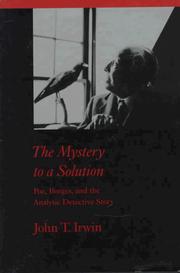
The Mystery to a Solution
John T. Irwin · 1993
על הספר
When Poe invented the analytic detective genre in the 1840s with the three Dupin stories, his underlying project was to examine the very nature of self-consciousness. But the tradition of detective fiction these stories inspired would draw on only the most superficial aspects of his work. One hundred years after Poe, however, Borges would reinterpret the genre with three detective stories of his own and revive Poe's original, ambitious intention to analyze "the analytic power." In The Mystery to a Solution, John Irwin brilliantly examines the deeper significance of the genre Poe created and the meaning of Borges's efforts to "double" its origin. Using a methodology that combines history, literary history, and practical and speculative criticism, Irwin pursues the issues underlying the detective genre into areas as various as the history of mathematics, classical mythology, the double-mirror structure of self-consciousness, handedness, the anthropology of Evans and Frazer, the structure of chess, automata, the mind-body problem, the etymology of labyrinth, and scores of other topics. Irwin honors the aesthetic impact of the genre he discusses by mirroring in his study the dynamics of a detective story - the uncovering of mysteries, the accumulation of evidence, the tracing of clues, and the final solution that ties it all together.
המשפט הראשון: LET ME START WITH A simple-minded question: How does one write analytic detective fiction as high art when the genre's central narrative mechanism seems to discourage the unlimited rereading associated with serious writing?
פרטי הספר
- שנה
- 1993
- שפה
- English
- הוצאה
- The Johns Hopkins University Press
- מהדורות
- 2
- עמודים
- 512
- ISBN
- 9780801846502
מקור הנתונים: Wikidata
עוד של John T. Irwin