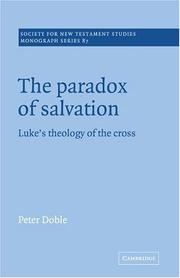
The paradox of salvation
Peter Doble · 1996
על הספר
Refuting the allegation that the author of Luke-Acts showed no systematic thought about the significance of Jesus' death, this study affirms that Luke had a coherent theologia crucis. Peter Doble focuses sharply on the Gospel's death scene and explores three features which appear in Luke alone, then extends the exploration into the longer account of Jesus' final days in Jerusalem. The three Lukan features are first, that the centurion calls Jesus 'dikaios' rather than the 'Son of God' of Mark and Matthew; Doble examines Luke's use of the word in his Gospel and in Acts, and shows that its presence and force come from the Wisdom of Solomon. Second, in Luke, Jesus' final word from the cross, different from that in Mark and Matthew, belongs to the same Wisdom model. Third, the centurion in Luke, seeing the manner of Jesus' death, is said to have 'glorified God', and this is shown to be a Lukan verbal signal which appears whenever the evangelist wants to show that an element in the salvation programme has been fulfilled. In the final section Doble demonstrates how specific words and patterns from Wisdom shape and fill Luke's retelling of the story of Jesus' entrapment, trials and death. Luke wanted his readers to understand that what had happened to Jesus was not a humiliating rejection but in accord with scripture's presentation of God's plan, and culminated in the 'paradox' of his salvation.
המשפט הראשון: It is frequently alleged that Luke has no theologia crucis, or, at best, a weakened one.
פרטי הספר
- שנה
- 1996
- שפה
- English
- הוצאה
- Cambridge University Press
- מהדורות
- 4
- עמודים
- 286
- ISBN
- 9780521018869
מקור הנתונים: Wikidata