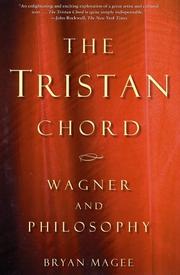
The Tristan chord
Bryan Magee · 2000
על הספר
"Richard Wagner's wildly enthusiastic devotees have ranged from the most subtle and intelligent minds (Marcel Proust) to the most crudely brutal (Adolf Hitler). The enduring fascination of his works arises not only from his singular fusion of musical innovation and theatrical daring, but also from his largely overlooked engagement with the boldest investigations of modern philosophy." "Now, in this book, Bryan Magee, a distinguished Wagnerian and a teacher of philosophy, traces the composer's involvement in the intellectual guests of his age, from his youthful embrace of revolutionary socialism, to a Schopenhauerian rejection of the world as illusion, to the near-Buddhist resignation of his final years. Mapping the influence of ideas on Wagner's art, Magee shows how abstract thought can permeate musical work and stimulate creations of great power and beauty. With sympathy and perception, he explores the relationship between words and music, mind and feeling, conscious and unconscious motivations. And he unflinchingly confronts the Wagner whose paranoia, egocentricity, and anti-Semitism are as repugnant as his achievements are glorious."--Jacket.
המשפט הראשון: The key to the nature of opera in general is that it is a form of drama in which the primary means of expression is music.
פרטי הספר
- שנה
- 2000
- שפה
- English
- הוצאה
- Henry Holt and Co.
- מהדורות
- 3
- עמודים
- 397
- ISBN
- 9780805071894
מקור הנתונים: Wikidata
עוד של Bryan Magee