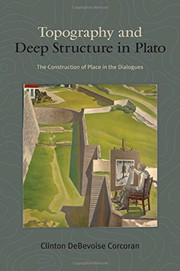
Topography and Deep Structure in Plato
Clinton DeBevoise Corcoran · 2016
על הספר
Clinton DeBevoise Corcoran examines the use of place in Plato's dialogues. Corcoran argues that spatial representations, such as walls, caves, and roads, as well as the creation of eternal patterns and chaotic images in the dialogues, provide clues to Plato's philosophic project. Specifically, the Good serves as an overarching ordering principle for the construction of place and the proper limit of spaces here in the world, deep in the underworld, or in the nonspatial ideal realm of the Forms. The Good equips Plato with a powerful mythopoetic tool to create settings, frames, and arguments that superimpose different dimensions of reality, allowing worlds to overlap that would otherwise be incommensurable. Corcoran explores how Plato uses wrestling and war as metaphors for the mixing of the nonspatial, eternal forms in the world and history, and how he uses spatial images throughout the dialogues to critique Athens's tragic overreach in the Peloponnesian War. -- Adapted from the cover.
פרטי הספר
- שנה
- 2016
- שפה
- English
- הוצאה
- State University of New York Press
- מהדורות
- 2
- עמודים
- 302
- ISBN
- 9781438462691
מקור הנתונים: Wikidata