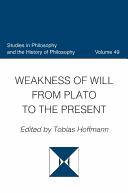
Weakness of will from Plato to the present
Tobias Hoffmann · 2008
על הספר
This volume contains 13 original essays on weakness of will by scholars of contemporary philosophy and the history of philosophy. It covers the major periods of Western philosophy. Kenneth Dorter. “Weakness and Will in Plato’s Republic,” pp. 1–21: Plato notes that self-mastery is paradoxical because someone who is master of himself is equally subject to himself. He resolves the paradox by dividing the self into better and worse parts, and defining self-mastery as the rule of the better over the worse. But Plato also recognizes the serious obstacles to demonstrating that our self is composed of parts, or that one part is better than another, and shows the limitations of his demonstrations and how to go beyond them. To appreciate his full teaching we must go beyond Book 4 to the later books of the Republic. Terence H. Irwin. “Aristotle Reads the Protagoras,” pp. 22–41: When Aristotle attributes to Socrates the denial of the possibility of incontinence, his account is based on the Protagoras. But Aristotle’s attitude toward the Protagoras is different in the Magna Moralia and the later treatment of Nicomachean Ethics 7. Only in EN 7 does Aristotle refer to Socrates’ view in the Protagoras that knowledge is not dragged around like a slave by passion. It is argued that Aristotle adds this specific reference in his later treatment because he now recognizes that Socrates says something true here. Only perceptual knowledge, not knowledge in the full sense, is dragged around by passion. Lloyd Gerson. “Plotinus on Akrasia: The Neoplatonic Synthesis,” pp. 42–57: This paper argues that Plotinus appropriates Peripatetic and Stoic insights into his expression of Platonic moral psychology generally and into his analysis of akrasia in particular. Plotinus’s account focuses on the Platonic distinction between the soul or true self and the embodied composite human being. With the Stoics, Plotinus argues that the true self is the subject of rational desire. Rational desire is here interpreted as a second-order desire in relation to the first-order desires of the composite individual. Plotinus argues along Platonic lines that vicious and akratic actions are involuntary because they arise from desires involving embodiment. James Wetzel. “Body Double: Saint Augustine and the Sexualized Will,” pp. 58–81: In Confessions 8, Augustine describes being unresolved between two wills: one pulling him back to a discredited life of sexual habit, the other pushing him forward to a resurrec
פרטי הספר
- שנה
- 2008
- שפה
- English
- סדרה
- Studies in philosophy and the history of philosophy -- v. 49
- הוצאה
- Catholic University of America Press
- מהדורות
- 1
- עמודים
- 316
- ISBN
- 9780813215204
מקור הנתונים: Wikidata
עוד של Tobias Hoffmann