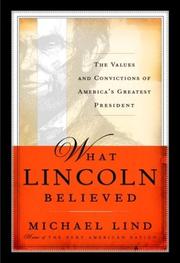
What Lincoln believed
Michael Lind · 2005
על הספר
This intellectual biography uncovers the heart of Lincoln's public philosophy and places his ideals and presidential decisions within the context of his times. Lind dispels the popular image of Lincoln as a self-made man and a naive, inspired genius, and shows that the president was very much a product of his time and place, influenced by the pragmatism of his fellow Kentuckian Henry Clay, and by Enlightenment thinking. Lind asserts that Lincoln fought the Civil War not to free the slaves, or even to preserve the Constitution, but to ensure the survival of democracy. With the failure of numerous liberal revolutions throughout Europe in 1848 heightening the possibility that democracy itself would be deemed a noble but failed experiment, Lincoln realized that the stakes in the Civil War were nothing less than the future freedom and prosperity of all mankind. It was this conviction that determined his policies and compelled him to wage the war to the bitter end. Lind also reveals that Lincoln was not a Christian, but a deist who believed in the abstract deity posited by Enlightenment philosophers; and that although he believed slavery was evil, he opposed the idea of a multiracial country and supported the relocation of black Americans abroad.
המשפט הראשון: IN 1863 THE democratic republic as a form of government was rare-and in danger of extinction.
פרטי הספר
- שנה
- 2005
- שפה
- English
- הוצאה
- Anchor
- מהדורות
- 1
- עמודים
- 368
- ISBN
- 9781400030736
מקור הנתונים: Wikidata
עוד של Michael Lind