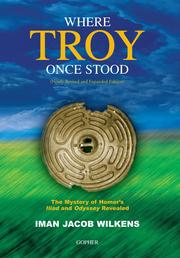
Where Troy Once Stood
Iman Jacob Wilkens · 2008
איפה לקנות
בדקו את המחיר העדכני באמזון. אנחנו לא מציגים מחירים כי הם משתנים מדי יום.
לצפייה באמזוןקישור שותפים. בתור שותפים של Amazon אנחנו מרוויחים מרכישות מתאימות.
על הספר
This work puts an end to the traditional interpretation of both the Iliad and Odyssey of Homer, much to the displeasure of many who are unable to counter the basic arguments of its author and realize that their own ideas and dogma's exploded. On the basis of linguistic, historical and archaeological evidence it shows that the oldest European epics did not originate in Greece but with the Sea Peoples from the coastal areas of Western Europe, thus radically overturning received wisdom by uncovering the existence of a sophisticated Celtic civilisation in the second millennium BC. Several ancient Greek authors already doubted that Homer's works were of Greek origin, while also some contemporary scholars recognize that the poet had not described Mycenaean culture at all and that Hissarlik in Turkey could not have been the site of the great Trojan War as was thought by Schliemann in the 19th century and still today by Korfmann, despite the fact that not a single one of forty characteristics of Troy and the Trojan plain as described by Homer fit the region. By contrast, all these features apply to the plains near Cambridge and the Gog Magog Hills, the archaeological site which owes its name to the most terrible war of prehistory mentioned in the Bible. Here, the names of a dozen rivers mentioned in the Iliad can still be recognized, while hundreds of bronze weapons were found dated to the later Bronze Age, c.1200 BC. The lay-out of the battlefield is reconstructed in great detail enabling readers henceforth to follow the military action in the field. Several features are still extant, such as the war-dikes and the canal dug to protect the Achaean camp. (see: www.troy-in-england.co.uk). The war was started by the Achaeans (not the Greeks, an anachronism found in many translations of Homer) who were Celts living on the Continent, against the Trojans, who were Celts living in England. The Achaeans were led by 'wide-ruling' Agamemnon, king of Argos in northern France a part of which is now called Argonne. His capital city on the Seine, Mycenae, is now called Troyes. According to the analysis of the 'Catalogue of Ships' in book II of the Iliad his allies came from coastal areas situated between Scandinavia and Spain. The king of the Trojans, Priam, was supported by allies from Scotland, Wales, Cornwall and western Brittany. His capital Troy was destroyed but rebuilt by Brutus, the great-grandson of Aeneas, on the river Thames on his return from exile in the Mediterran
פרטי הספר
- שנה
- 2008
- שפה
- English
- הוצאה
- Gopher Publishers
- מהדורות
- 2
- עמודים
- 432
- ISBN
- 9789051795356
מקור הנתונים: Wikidata