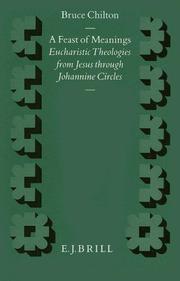
A Feast of Meanings
Bruce Chilton · 1994
Where to buy
Amazon’s price changes daily, so the most accurate place to see it is there, at the moment you buy.
View on AmazonAbout the book
The monograph analyzes eucharistic texts on the basis of the social practices which generated them. Six stages of ideology are identified. Jesus himself practised fellowship at meals as celebrations of Israel's purity (stage 1), and later insisted that a pure meal was a better sacrifice than an offering in the Temple (stage 2). The circle of Peter made such meals into covenantal celebrations; Jesus became a new Moses (stage 3). In order to militate against the full participation of non-Jews, the circle of James invented the full identifications with Passover (stage 4). Paul resisted any such limitations (stage 5). The Synoptic tradition accepted the Jacobean chronology, but joined Paul in developing the Hellenistic theme of Jesus as heroic martyr, and in explaining eucharist as a means of effecting solidarity with Jesus (stage 5). The Johannine ideologies transformed the idiom of eucharist by making Jesus into the paschal lamb which is consumed (stage 6). A conclusion relates the practices identified to the sources behind the Gospels, and shows how practice is key to the meanings of eucharistic texts.
Book details
- Year
- 1994
- Language
- English
- Publisher
- Brill Academic Publishers
- Editions
- 1
- Pages
- 210
- ISBN
- 9789004099494
Data source: Wikidata
More by Bruce Chilton