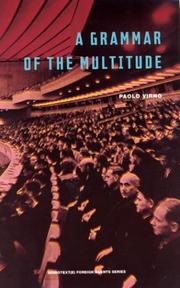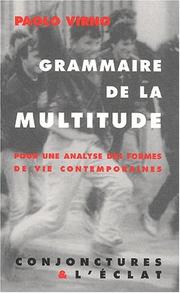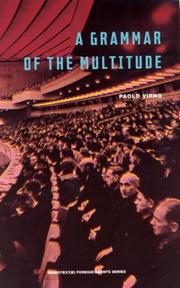
A Grammar of the Multitude
Paolo Virno · 2003
Where to buy
Amazon’s price changes daily, so the most accurate place to see it is there, at the moment you buy.
View on AmazonAbout the book
Italian political thinker Paolo Virno argues that the category of "multitude" is a far better tool to analyze contemporary issues than the Hobbesian concept of "people." Globalization is forcing us to rethink some of the categories -- such as "the people" -- that traditionally have been associated with the now eroding state. Italian political thinker Paolo Virno argues that the category of "multitude," elaborated by Spinoza and for the most part left fallow since the seventeenth century, is a far better tool to analyze contemporary issues than the Hobbesian concept of "people," favored by classical political philosophy. Hobbes, who detested the notion of multitude, defined it as shunning political unity, resisting authority, and never entering into lasting agreements. "When they rebel against the state," Hobbes wrote, "the citizens are the multitude against the people." But the multitude isn't just a negative notion, it is a rich concept that allows us to examine anew plural experiences and forms of nonrepresentative democracy. Drawing from philosophy of language, political economics, and ethics, Virno shows that being foreign, "not-feeling-at-home-anywhere," is a condition that forces the multitude to place its trust in the intellect. In conclusion, Virno suggests that the metamorphosis of the social systems in the West during the last twenty years is leading to a paradoxical "Communism of the Capital."
Book details
- Year
- 2003
- Language
- English
- Series
- Semiotext(e) foreign agents series
- Publisher
- Semiotext(e)
- Editions
- 1
- Pages
- 117
- ISBN
- 9781584350217
Data source: Wikidata
More by Paolo Virno