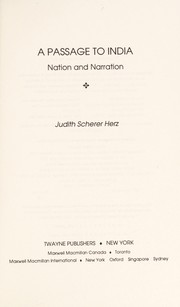
A passage to India
Judith Scherer Herz · 1992
Where to buy
Amazon’s price changes daily, so the most accurate place to see it is there, at the moment you buy.
View on AmazonThis is an affiliate link: if you buy through it, the site earns a small commission at no extra cost to you, which helps us bring quality content and maintain the site. As an Amazon Associate we earn from qualifying purchases.
About the book
The greatness of E.M. Forster's fifth and last novel, A Passage to India, rests in part on its agility. It is at once political tract, personal memoir, philosophical meditation, comedy of manners, mystery, even ghost story. It accommodates the workings of reason and the supernatural, the sensibilities of West and East, the experiences of conqueror and subject. It is a colonial as well as a postcolonial text, a participant in both the realist and modernist traditions. In her ample, well-furnished response to Forster's masterpiece, Judith Scherer Herz combines a political and historical reading with one focusing on narrative technique. This unusual approach allows for a rich accounting of the multitude of forces at work in the novel, enabling her to determine as precisely as possible the events, beliefs, values, and cultural assumptions that inform it.^ The reasons for the British presence in India, the extent of their power over the Indians, the many and complex reactions of the Indians to that power, the role and reliability of Forster's narrator as arbiter and truthteller, the extent to which that narrator gives voice to Forster's personal experience of India - all are brought to light in Herz's analysis. This assessment of the book's more tangible elements is complemented by Herz's recognition of its intangible elements, its ghosts, those presences that exist within its imaginative world but not necessarily on the page. The novel's "ghost story," Herz writes, "occurs in the spaces of the primary text; in dreams, memories, old photographs, and flashes of intuition that do not quite resolve." While some critics have dealt with the supernatural in Forster's work, Herz is the first to use the idea of the ghost story to come to grips with the essential elusiveness and secrecy of A Passage to India.^ Herz's willingness to explore the least chartered, least expressible territory of the novel, coupled with her informed criticism of the primary text, sets her work apart from other Forster studies to date.
Book details
- Year
- 1992
- Language
- English
- Publisher
- Twayne Publishers
- Editions
- 1
- Pages
- 151
- ISBN
- 9780805781045
Data source: Wikidata