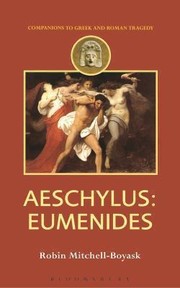
Aeschylus Bcp Classics Companions
Robin Mitchell-Boyask · 2010
Where to buy
Amazon’s price changes daily, so the most accurate place to see it is there, at the moment you buy.
View on AmazonAbout the book
"The 'Eumenides', the concluding drama in Aeschylus' sole surviving trilogy, the "Oresteia", is not only one of the most admired Greek tragedies, but also one of the most controversial and contested, both to specialist scholars and public intellectuals. It stands at the crux of the controversies over the relationship between the fledgling democracy of Athens and the dramas it produced during the City Dionysia, and over the representation of women in the theatre and their implied status in Athenian society. The "Eumenides" enacts the trial of Agamemnon's son Orestes, who had been ordered under the threat of punishment by the god Apollo to murder his mother Clytemnestra, who had earlier killed Agamemnon. In the Eumenides, Orestes, hounded by the Eumenides (Furies), travels first to Delphi to obtain ritual purgation of his mother's blood, and then, at Apollo's urging, to Athens to seek the help of Athena, who then decides herself that an impartial jury of Athenians should decide the matter. Aeschylus thus presents a drama that shows a growing awareness of the importance of free will in Athenian thought through the mythologized institution of the first jury trial."--Bloomsbury Publishing The "Eumenides", the concluding drama in Aeschylus' sole surviving trilogy, the "Oresteia", is not only one of the most admired Greek tragedies, but also one of the most controversial and contested, both to specialist scholars and public intellectuals. It stands at the crux of the controversies over the relationship between the fledgling democracy of Athens and the dramas it produced during the City Dionysia, and over the representation of women in the theatre and their implied status in Athenian society. The "Eumenides" enacts the trial of Agamemnon's son Orestes, who had been ordered under the threat of punishment by the god Apollo to murder his mother Clytemnestra, who had earlier killed Agamemnon.In the "Eumenides", Orestes, hounded by the Eumenides (Furies), travels first to Delphi to obtain ritual purgation of his mother's blood, and then, at Apollo's urging, to Athens to seek the help of Athena, who then decides herself that an impartial jury of Athenians should decide the matter. Aeschylus thus presents a drama that shows a growing awareness of the importance of free will in Athenian thought through the mythologized institution of the first jury trial
Book details
- Year
- 2010
- Language
- English
- Publisher
- Bristol Classical Press
- Editions
- 1
- Pages
- 144
- ISBN
- 9780715636428
Data source: Wikidata