al-Andalus
Jerrilynn Denise Dodds · 1992
Where to buy
Amazon’s price changes daily, so the most accurate place to see it is there, at the moment you buy.
View on AmazonThis is an affiliate link: if you buy through it, the site earns a small commission at no extra cost to you, which helps us bring quality content and maintain the site. As an Amazon Associate we earn from qualifying purchases.
About the book
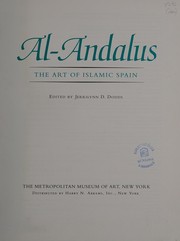
In 711 an army of Arabs and Berbers from North Africa, united by their faith in Islam, crossed the Strait of Gibraltar and arrived on the Iberian Peninsula. In less than a decade the Muslims brought most of the peninsula under their domination; they called the Iberian lands they controlled al-Andalus. Although the borders of al-Andalus shifted over the centuries, the Muslims remained a powerful force on the peninsula for almost eight hundred years, until 1492, when they were expelled by Ferdinand and Isabella. This volume, which accompanies a major exhibition presented at the Alhambra in Granada and The Metropolitan Museum of Art in New York, is devoted to the little-known artistic legacy of Islamic Spain. From 711 to 1492 al-Andalus was the occidental frontier of Islam. Floating on the western edge of the Mediterranean, cut off from the European continent by jagged mountains, it was geographically isolated from both North Africa and Europe, from Islamic as well as Christian lands. Physical remoteness gave al-Andalus a privileged place in medieval myths but also separated it from the communities of the east and the west, so that it received only sporadic attention from both worlds. Although a small group of scholars pursued the serious study of the arts of Islamic Spain, these arts have for the most part been viewed as brilliant and exotic vestiges of a lost culture, as objects and monuments that left no mark on European tradition. A goal of this book, the first publication in over forty years to study the art and architecture of al-Andalus in depth, is to reveal the value of these arts as part of an autonomous culture and also as a presence with deep significance for both Europe and the Islamic world. Toward this end, twenty-four international scholars have contributed a wide-ranging series of essays and catalogue entries in which the art, architecture, and cultural climate of al-Andalus are approached from a broad variety of perspectives. A significant achievement of this volume, in fact, is that it brings together American and European scholars, two groups that until now have worked largely in isolation from each other. Most of the art and architecture that remains from Islamic Spain was produced for palatine settings and aristocratic patrons; representing, as these works do, almost eight centuries of history, they issue from diverse rules and traditions. The lavishly illustrated essays and catalogue entries present the full spectrum of the art of al-An
Book details
- Year
- 1992
- Language
- English
- Publisher
- Distributed by H.N. Abrams
- Editions
- 1
- Pages
- 432
- ISBN
- 9780870996368
Data source: Wikidata
More by Jerrilynn Denise Dodds