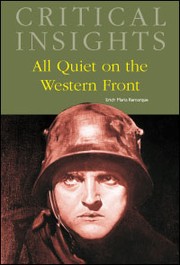
All quiet on the western front
Brian Murdoch · 2010
Where to buy
Amazon’s price changes daily, so the most accurate place to see it is there, at the moment you buy.
View on AmazonAbout the book
"Finally, the truth about war," reviewers proclaimed when All Quiet on the Western Front was published in 1928, ten years after World War I had ended. Shockingly direct, it painted a decidedly unromantic portrait of the war in which Remarque had briefly fought and quickly became an international sensation. Around the world, readers who were still trying to comprehend the war and the devastation it had wreaked across the land, society, and culture of Western Europe found an answer in Western Front. And today, even after eighty years and after tens of millions of soldiers have died in wars, readers keep turning to the novel for answers. Edited and with an introduction by Brian Murdoch, Professor Emeritus of German at the University of Stirling in Scotland, this volume in the Critical Insights series brings together a wide variety of introductory and in-depth essays on Remarque's classic war novel. Murdoch's introduction examines the novel's often overlooked subtleties of tone, characterization, and plot, and Ruth Franklin, writing on behalf of The Paris Review, reflects on Remarque's startling direct style and his relevance to twenty-first-century readers. For those encountering All Quiet on the Western Front for the first time, a quartet of new introductory essays provide a framework for building a deeper understanding of the novel. Thomas Schneider situates it within the culture and politics of Weimar Germany as well as early twentieth-century German war literature, and Mark Ward offers a comprehensive survey of the novel's popular and critical reception. Peter Hutchinson analyzes the intricacies of Remarque's style and structuring, and Matthew J. Bolton compares All Quiet on the Western Front with another iconic novel of World War I, Ernest Hemingway's A Farewell to Arms. Next, a collection of classic and contemporary essays dive into the novel's key contexts and themes. A 1929 correspondence between Remarque and a British general illuminates, in Remarque's own words, his intentions in writing the novel. An excerpt from Hilton Tims's recent biography of Remarque offers an account of the German public's sensational response to All Quiet on the Western Front. Alan F. Bance, too, takes up the public response to the novel, pinpointing various facets that could simultaneously appeal to some readers and alienate or enrage others. Modris Eksteins in turn contextualizes the novel within the international postwar culture, particularly against the war literature of
Book details
- Year
- 2010
- Language
- English
- Publisher
- Salem Press
- Editions
- 1
- Pages
- 377
- ISBN
- 9781587657191
Data source: Wikidata
More by Brian Murdoch