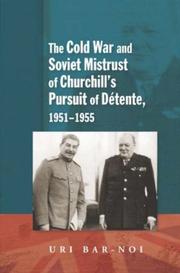
Anglo-soviet Relations During Churchill's Peacetime Administration
Uri Bar-Noi · 2008
Where to buy
Amazon’s price changes daily, so the most accurate place to see it is there, at the moment you buy.
View on AmazonAbout the book
"After Josef Stalin's death in March 1953, detente remained a distant reality. The collective leadership was keen to reduce international tensions without modifying its predecessor's foreign policy, or abandoning Soviet strongholds of central and eastern Europe. As part of its peace offensive, the Kremlin was prepared to improve the atmosphere in relations with Britain and increase the volume of Anglo-Soviet trade. However, the British remained mistrustful of the intentions of Stalin's successors, and refrained from initiatives leading to a relaxation of export controls independent from American embargo policy." "The author demonstrates that Stalin's heirs suspected that Churchill's pursuit of detente was designed to secure far-reaching concessions. Moscow also felt that as a junior partner acting in full dependence on and in cooperation with US policy, Churchill was in no position to conciliate between the USSR and the USA. Engaged in a domestic struggle for power, members of the collective leadership were reluctant to allow their opponent, Georgi Malenkov, to negotiate single-handedly with western statesmen. It was only after Nikita Khrushchev's ascendance to power and Churchill's resignation from office that the Kremlin was prepared to participate in summit talks with the western heads of government."--Jacket.
Book details
- Year
- 2008
- Language
- English
- Publisher
- Sussex Academic Pr
- Editions
- 1
- Pages
- 248
- ISBN
- 9781845191764
Data source: Wikidata