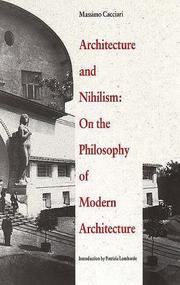
Architecture and nihilism
Massimo Cacciari · 1995
Where to buy
Check today’s price on Amazon. We do not show prices because they change daily.
View on AmazonAffiliate link. As an Amazon Associate we earn from qualifying purchases.
About the book
"Massimo Cacciari, one of the most influential social philosophers in Italy today, is the founder of the trend of criticism known as "negative thought" that focuses on the failure of traditional logic to explicate the problems of modernity. This book, which introduces his writings to an English-speaking audience, provides a striking social and philosophical account of the twentieth-century metropolis. Patrizia Lombardo's extensive introduction situates Cacciari's thought within the milieu of Italian political activism and philosophy between the 1960s and the 1980s, from his collaboration on the leftist journal Contropiano to his long association with Manfredo Tafuri.". "Cacciari studies the relation between philosophy and modern architecture and applies the thinking of avant-garde architects, artists, and writers to the social and political problems raised by technological society. He begins by defining the modern metropolis, using the terms and ideas of Georg Simmel and Max Weber, but revealing where their frameworks are limited. He then examines the work of Adolf Loos and other architects and designers in early twentieth-century Vienna, showing how their architecture and criticism expose the alienation and utopianism in notions of the organic city. Cacciari demonstrates how architecture intersects with the city and the state but also with the interior of the private dwelling and with its resistance to the external world. Bringing together philosophy, sociology, urbanism, labor history, economics, and aesthetics, he helps us comprehend via these disciplines a crucial period in the history of modernity."--BOOK JACKET.
Book details
- Year
- 1995
- Language
- English
- Publisher
- Yale University Press
- Editions
- 1
- Pages
- 288
- ISBN
- 9780300063042
Data source: Wikidata
More by Massimo Cacciari