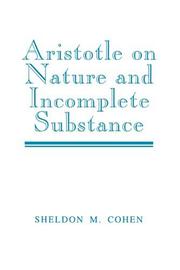
Aristotle on nature and incomplete substance
Sheldon M. Cohen · 1996
Where to buy
Amazon’s price changes daily, so the most accurate place to see it is there, at the moment you buy.
View on AmazonAbout the book
This book examines Aristotle's metaphysics and his account of nature, stressing the ways in which his desire to explain observed natural processes shaped his philosophical thought. It departs radically from a tradition of interpretation in which Aristotle is understood to have approached problems with a set of abstract principles in hand - principles derived from critical reflection on the views of his predecessors. A central example in the book interprets Aristotle's essentialism as deriving from an examination of the kinds of unity that various sorts of things have, and from his account of elemental motion, alteration, transformation, and the growth of organisms. An important conclusion of this argument is that a substance may, under certain circumstances, lack some of its essential attributes. The book goes on to develop a notion of incomplete substance and explores the connection between Aristotle's concept of nature and its role in scientific explanation. In this way Cohen breaks down the sharp division that many interpreters have chosen to see between Aristotle's natural science and his philosophy. This is a major reevaluation of Aristotle's metaphysics that will interest philosophers, classicists, and historians of classical science.
First sentence: To the delight of scholars, Aristotle's surviving writings are both extensive and obscure.
Book details
- Year
- 1996
- Language
- English
- Publisher
- Cambridge University Press
- Editions
- 2
- Pages
- 202
- ISBN
- 9780521533133
Data source: Wikidata