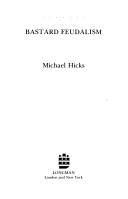
Bastard feudalism
Hicks, M. A. · 1995
Where to buy
Amazon’s price changes daily, so the most accurate place to see it is there, at the moment you buy.
View on AmazonThis is an affiliate link: if you buy through it, the site earns a small commission at no extra cost to you, which helps us bring quality content and maintain the site. As an Amazon Associate we earn from qualifying purchases.
About the book
'Bastard Feudalism' is the term historians give to the tie that bound late medieval retainers to their lords, and allowed those lords in turn to wield the political power, and cut the figure, appropriate to their rank. Without it, the late medieval aristocracy would not have been able to rule their localities, and fight the wars (at home as well as abroad) that were such a prominent feature of the fourteenth and fifteenth centuries. It is thus of fundamental importance to our understanding of the late medieval world - its warfare, local government, justice and public order, as well as its politics and social structure. But bastard feudalism had a longer-term significance, too: by involving payment (rather than the grant of land) in return for service, it contributed to the increasing mobility of society that marks the transition to the early modern world. . This major work now offers the most radical reinterpretation of the subject for fifty years, transforming our understanding of it and setting a fresh agenda for future work in the field. Michael Hicks argues that bastard feudalism started far earlier and lasted far longer than scholars have traditionally allowed; and that it was far more complex - and often much more positive - in its effects than its conventional image as a source of instability and abuse. Traditionally the concept has been linked almost exclusively to the non-resident gentry of 1300-1500 (the so-called indentured retainers). This book by contrast deals with the period from 1150 to 1650, and reveals more continuity than change over the five centuries it spans. It demonstrates that the most important retainers throughout the period were in fact the members of the lord's own household and the tenants of his estates, men whose bonds with their lord were particularly strong and enduring. Indentured retainers were unusual, and had all but disappeared by 1470. Because these ties were stable, Professor Hicks argues, society founded on them was also predominantly stable. While bastard feudalism could be used to pervert justice and promote violence and civil war, he shows that its prime functions were peaceful and ceremonial, and that it normally operated within the law and was increasingly regulated by it.
Book details
- Year
- 1995
- Language
- English
- Publisher
- Taylor & Francis Group
- Editions
- 4
- Pages
- 240
- ISBN
- 9781138836396
Data source: Wikidata