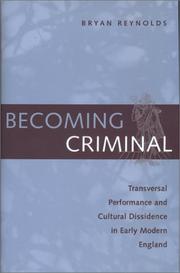
Becoming criminal
Bryan Reynolds · 2003
Where to buy
Amazon’s price changes daily, so the most accurate place to see it is there, at the moment you buy.
View on AmazonThis is an affiliate link: if you buy through it, the site earns a small commission at no extra cost to you, which helps us bring quality content and maintain the site. As an Amazon Associate we earn from qualifying purchases.
About the book
"In this book Bryan Reynolds argues that early modern England experienced a sociocultural phenomenon, unprecedented in English history, which has been largely overlooked by historians and critics. Beginning in the 1520s, a distinct "criminal culture" of beggars, vagabonds, confidence tricksters, prostitutes and gypsies emerged and flourished. This community defined itself through its criminal conduct and dissident thought and was, in turn, officially defined by and against the dominant conceptions of English cultural normality." "Examining plays, popular pamphlets, laws, poems, and scholarly work from the period, Reynolds demonstrates that this criminal culture, though diverse, was united by its own ideology, language and aesthetic. Using his transversal theory, he shows how the enduring presence of this criminal culture markedly influenced the mainstream culture's aesthetic sensibilities, socioeconomic organization, and systems of belief. He maps the effects of the public theater's transformative force of transversality, such as through the criminality represented by Shakespeare, Jonson, Middleton, and Dekker, on both Elizabethan and Jacobean society and the scholarship devoted to it."--Jacket.
Book details
- Year
- 2003
- Language
- English
- Publisher
- Johns Hopkins University Press
- Editions
- 1
- ISBN
- 9780801876752
Data source: Wikidata
More by Bryan Reynolds