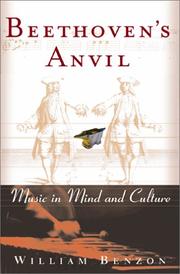
Beethoven's Anvil
William L. Benzon · 2002
Where to buy
Amazon’s price changes daily, so the most accurate place to see it is there, at the moment you buy.
View on AmazonThis is an affiliate link: if you buy through it, the site earns a small commission at no extra cost to you, which helps us bring quality content and maintain the site. As an Amazon Associate we earn from qualifying purchases.
About the book
Why does the brain create music? What is it about certain abstract patterns of sound that makes us want to dance? How can songs have deep emotional power despite lyrics that are simple and trite? We tend to think of the arts as luxuries rather than necessities, and as inventions of society rather than evolution. Yet the origin of musical ability was a turning point in the evolution of modern humans. Every culture, without exception, has some form of music. Is this really a luxury or does it answer some basic biological need? If so, what? In Beethoven's Anvil, William Benzon takes up the fascinating and unexplored link between music and the brain. Among early humans, he says, there was no distinction between music, dance, ritual and religion—they were all part of the same activity, and this activity used every part of the conscious brain. Language, movement, vision, emotion, hearing, touch and social interaction were all involved. In fact, Benzon argues, music is necessary precisely because it engages so many different parts of the brain. It literally keeps the brain in tune with itself and with the brains of others. The ultimate form of musical experience is that feeling of oneness with a larger entity that we identify as transcendent religious experience. We feel this way because that’s precisely what the brain is doing: becoming one with a larger unit, the human tribe.
Book details
- Year
- 2002
- Language
- English
- Publisher
- Basic Books
- Editions
- 1
- Pages
- 352
- ISBN
- 9780465015443
Data source: Wikidata