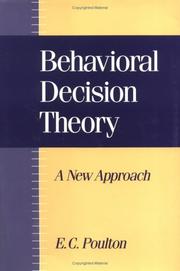
Behavioral decision theory
E. C. Poulton · 2011
Where to buy
Check today’s price on Amazon. We do not show prices because they change daily.
View on AmazonAffiliate link. As an Amazon Associate we earn from qualifying purchases.
About the book
This book discusses the well-known fallacies of behavioral decision theory. It shows that while an investigator is studying a well-known fallacy, he or she may introduce, without realizing it, one of the simple biases that are found in quantifying judgments. The work covers such fallacies as the apparent overconfidence that people show when they judge the probability of correctness of their answers to two-choice general knowledge questions using a one-sided rating scale; the apparent overconfidence in setting uncertainty bounds on unknown quantities when using the fractile method; the interactions between hindsight and memory; the belief that small samples are as reliable and as representative as are large samples; the conjunction fallacy for Linda and Bill; the causal conjunction fallacy; the regression fallacy in prediction; the neglect of the base rate in the Cab problem, in predicting professions, and in the Medical Diagnosis problem; the availability and simulation fallacies; the anchoring and adjustment biases; Prospect theory; and bias by frames.
Book details
- Year
- 2011
- Language
- English
- Publisher
- Cambridge University Press
- Editions
- 2
- ISBN
- 9780511890710
Data source: Wikidata