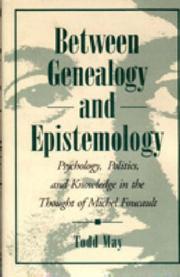
Between genealogy and epistemology
Todd May · 1993
Where to buy
Amazon’s price changes daily, so the most accurate place to see it is there, at the moment you buy.
View on AmazonAbout the book
Michel Foucault introduced a new form of political thinking and discourse. Rather than seeking to understand the grand unities of state, economy, or exploitation, he tried to discover the micropolitical workings of everyday life that have often founded the greater unities. He was particularly concerned with how we understand ourselves psychologically, and thus with how psychological knowledge developed and came to be accepted as true. In the course of his writings, he developed a genealogy of psychology, an account of psychology as a historically developed practice of power. The problem such an account raises for much of traditional philosophy is that Foucault's critique of psychological concepts is ultimately a critique of the idea of the mind as a politically neutral ontological concept. As such, it renders politically suspect all forms of subjective foundationalism, and the epistemological justification for Foucault's own writings is then called into question. Drawing on the writings of such Anglo-American philosophers as Wilfrid Sellars and Ludwig Wittgenstein, Todd May refutes the idea that Foucault's critiques of knowledge, and especially psychological knowledge, undermine themselves.
Book details
- Year
- 1993
- Language
- English
- Publisher
- Pennsylvania State University Press
- Editions
- 2
- Pages
- 144
- ISBN
- 9780271027821
Data source: Wikidata
More by Todd May