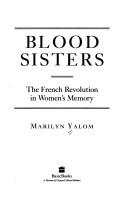
Blood Sisters
Marilyn Yalom · 1993
Where to buy
Amazon’s price changes daily, so the most accurate place to see it is there, at the moment you buy.
View on AmazonThis is an affiliate link: if you buy through it, the site earns a small commission at no extra cost to you, which helps us bring quality content and maintain the site. As an Amazon Associate we earn from qualifying purchases.
About the book
The promises of "liberty, equality, and fraternity" did not extend to women, but with the publication of Blood Sisters, the voices of the women who witnessed the French Revolution are finally restored to history. They left us an invaluable legacy - some eighty accounts of what they saw and experienced. These chronicles range from the sixteen-page testimonial of the Widow Bault, wife of the concierge in Marie-Antoinette's prison, to the ten-volume memoirs of the prolific writer Mme de Genlis; from the dictated life story of an illiterate peasant to acknowledged classics by Mme Roland and Mme de Stael. No other literature in the Western world offers such an early treasury of women recording their personal histories within the context of a great political cataclysm. Their stories describe how they participated, individually and collectively, in the revolutionary saga and how they sometimes succeeded in manipulating a political system designed to exclude them.^ Whatever their political loyalties, the women saw themselves as victims, and their accounts document the connection between gender and victimization. Yet they did not accept their victimization passively. The memoirists of Blood Sisters portray themselves as active participants cheering the Revolution on its course or, more frequently, resisting it. Marilyn Yalom singles out those who authored the most unforgettable chronicles: the governess of the royal children; the servant attending Marie-Antoinette in her last days; Robespierre's sister, Charlotte; the peasant woman from the Vendee who fought as a soldier; and, of course, Mme Roland, whose autobiography has enchanted readers for centuries. Aristocrats and bourgeois women, royalists and republicans, even the few peasant and working-class women who left accounts of their experiences - all were bound together by a common nightmare.^ These compelling human dramas - moving accounts of survival on the cusp of catastrophe - add suffering faces to the canvas of lofty thinkers and fiery orators who dominate the historiography of the Revolution. They tell us what it was like to suffer a miscarriage as the result of a street demonstration, to choose between nursing a baby and following a husband to war, to resist jailers' demands for sexual favors. A tragic note prevails: the sense of having survived when so many others perished often produced what we might now call "survivor's guilt." Their testimonies, Yalom argues, spring from an inner urgency to bear witne
Book details
- Year
- 1993
- Language
- English
- Publisher
- Pandora Press
- Editions
- 2
- Pages
- 308
- ISBN
- 9780044409182
Data source: Wikidata
More by Marilyn Yalom