Bourgeois dignity
Deirdre N. McCloskey · 2010
Where to buy
Amazon’s price changes daily, so the most accurate place to see it is there, at the moment you buy.
View on AmazonAbout the book
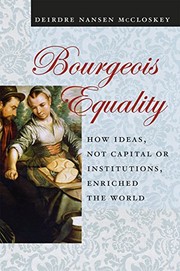
Bourgeois Dignity turns to seventeenth- and eighteenth-century Europe to reconsider the birth of the Industrial Revolution and the rise of capitalism. According to McCloskey our modern world was not the product of new markets or imperial theft, but rather of shifting opinions about the economy. Talk of private property, commerce, innovation, and the bourgeoisie radically altered, becoming far more approving and contradicting prejudices several millennia old. The wealth of nations, then, didn't grow so dramatically after 1800 because of economic factors; it grew because rhetoric about markets, enterprise, and innovation finally became enthusiastic and encouraging of their inherent dignity. Bourgeois Dignity retells the story of modern economic growth, recasting what we thought we knew from 1776 to the present. McCloskey tests the traditional stories against what actually happenedùand the usual stories don't work very well. Not Marx and his classes. Not Max Weber and his Protestants. Not Fernand Braudel and his Mafia-style capitalists. Not Douglass North and his institutions. Not the mathematical theories of endogenous growth. Not the left wing's theory of working-class struggle, nor the right wing's theory of spiritual decline. What works is "rhetoric." What people said about markets and innovation changed in Holland and then England and then the world. --Book Jacket.
Book details
- Year
- 2010
- Language
- English
- Publisher
- The University of Chicago Press
- Editions
- 1
- Pages
- 571
- ISBN
- 9780226556659
Data source: Wikidata
More by Deirdre N. McCloskey