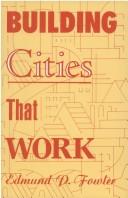
Building Cities That Work
Edmund P. Fowler · 1993
Where to buy
Check today’s price on Amazon. We do not show prices because they change daily.
View on AmazonAffiliate link. As an Amazon Associate we earn from qualifying purchases.
About the book
Building Cities That Work expands the current debate on urban development by integrating important aspects of city life that are often thought of separately. Using Jane Jacobs' critique of postwar city-building as a starting point, Edmund Fowler shows that recent North American urban development has been characterized by development projects on a massive scale, on indiscriminate use of vast areas of land, and an increasingly evident homogeneity. These are characteristics, he argues, of a perverse and unnatural way of building that is wrecking the planet and enfeebling our social and political networks. In monetary terms this kind of development costs us billions of dollars for transportation, utilities, and other municipal services--the ecological costs are incalculable. Land use patterns have not only helped to undermine community cohesiveness, they have also discouraged block-level democracy and the development of a sense of responsibility for one's locality. Children grow up without proper socialization and contribute to a thriving subculture of vandalism and other street crime. In answering the question of why we began developing cities in this way, Fowler used Toronto as a case study, conducting extensive field work in nineteen areas of the city. He shows not only that postwar building was the result of conscious public policy but goes further, arguing that our cities reflect deep-seated insecurities and cultural malaise in surprisingly direct ways. Tower concludes on a positive note, with many examples of how people have rethought their values and, in cooperation with their neighbours, have organized their physical and social environments on a small, ecologically friendly scale.
Book details
- Year
- 1993
- Language
- English
- Publisher
- McGill-Queen's University Press
- Editions
- 4
- Pages
- 336
- ISBN
- 9780773511835
Data source: Wikidata