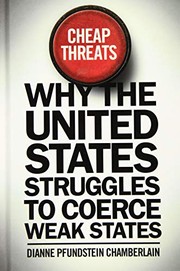
Cheap Threats
Where to buy
Amazon’s price changes daily, so the most accurate place to see it is there, at the moment you buy.
View on AmazonThis is an affiliate link: if you buy through it, the site earns a small commission at no extra cost to you, which helps us bring quality content and maintain the site. As an Amazon Associate we earn from qualifying purchases.
About the book
The United States has a huge advantage in military power over other states, yet it is frequently unable to coerce weak adversary states with threats alone. Instead, over the past two decades, the leaders of Iraq, Haiti, Serbia, Afghanistan, and Libya have dismissed US threats and invited military clashes. Why have weak states risked and ultimately suffered catastrophic defeat when giving in to US demands earlier might have allowed their survival? Why was it necessary to use force at all? Pfundstein finds that the United States' compellent threats often fail because the use of force has become relatively cheap for the United States in terms of political costs, material costs, and casualties. This comparatively low-cost model of war that relies on deficit spending, air power, high technology, and a light footprint by an all-volunteer force has allowed the United States to casually threaten force and frequently carry out short-term military campaigns. Paradoxically, this frequent use of "cheap" force has made adversary states doubt that the United States is highly motivated to bear high costs over a sustained period if the intervention is not immediately successful.
Book details
- Year
- 2016
- Language
- English
- Publisher
- Georgetown University Press
- Editions
- 4
- Pages
- 288
- ISBN
- 9781626162822
Data source: Wikidata