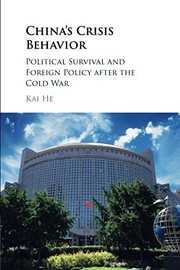
China's Crisis Behavior
Kai He · 2016
Where to buy
Amazon’s price changes daily, so the most accurate place to see it is there, at the moment you buy.
View on AmazonThis is an affiliate link: if you buy through it, the site earns a small commission at no extra cost to you, which helps us bring quality content and maintain the site. As an Amazon Associate we earn from qualifying purchases.
About the book
"Since the end of the Cold War, China has experienced several notable interstate crises: the 1999 'embassy bombing' incident, the 2001 EP-3 mid-air collision with a United States aircraft, and the Diaoyu/Senkaku dispute with Japan. China's response to each incident, however, has varied considerably. Drawing from a wealth of primary sources and interviews, this book offers a systematic analysis of China's crisis behavior in order to identify the factors which determine when Chinese leaders decide to escalate or scale down their response to crises. Inspired by prospect theory--a Nobel Prize-winning behavioural psychology theory--Kai He proposes a 'political survival prospect' model as a means to understand the disparities in China's behavior. He argues that China's response depends on a combination of three factors that shape leaders' views on the prospects for their 'political survival status,' including the severity of the crisis, leaders' domestic authority, and international pressure"--
Book details
- Year
- 2016
- Language
- English
- Publisher
- Cambridge University Press
- Editions
- 3
- Pages
- 186
- ISBN
- 9781107141988
Data source: Wikidata