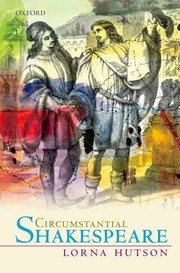
Circumstantial Shakespeare
Lorna Hutson · 2015
Where to buy
Amazon’s price changes daily, so the most accurate place to see it is there, at the moment you buy.
View on AmazonThis is an affiliate link: if you buy through it, the site earns a small commission at no extra cost to you, which helps us bring quality content and maintain the site. As an Amazon Associate we earn from qualifying purchases.
About the book
Shakespeare's characters are thought to be his greatest achievement-imaginatively autonomous, possessed of depth and individuality, while his plots are said to be second-hand and careless of details of time and place. . This view has survived the assaults of various literary theories and has even, surprisingly, been revitalized by the recent emphasis on the collaborative nature of early modern theatre. But belief in the autonomous imaginative life of Shakespeare's characters depends on another unexamined myth: the myth that Shakespeare rejected neoclassicism, playing freely with theatrical time and place. Circumstantial Shakespeare explodes these venerable critical commonplaces. Drawing on sixteenth-century rhetorical pedagogy, it reveals the importance of topics of circumstance (of Time, Place and Motive, etc.) in the conjuring of compelling narratives and vivid mental images. 'Circumstances'-which we now think of as incalculable contingencies-were originally topics of forensic inquiry into human intention or passion. In drawing on the Roman forensic tradition of circumstantial proof, Shakespeare did not ignore time and place.
Book details
- Year
- 2015
- Language
- English
- Publisher
- Oxford University Press
- Editions
- 3
- Pages
- 256
- ISBN
- 9780199657100
Data source: Wikidata
More by Lorna Hutson