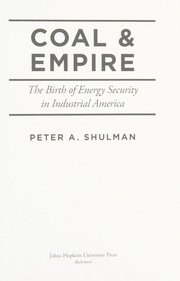
Coal & empire
Peter A. Shulman · 2015
Where to buy
Amazon’s price changes daily, so the most accurate place to see it is there, at the moment you buy.
View on AmazonThis is an affiliate link: if you buy through it, the site earns a small commission at no extra cost to you, which helps us bring quality content and maintain the site. As an Amazon Associate we earn from qualifying purchases.
About the book
"Since the early twentieth century, Americans have associated oil with national security. From World War I to American involvement in the Middle East, this connection has seemed a self-evident truth. But as Peter A. Shulman argues, Americans had to learn to think about the geopolitics of energy in terms of security, and they did so beginning in the nineteenth century: the age of coal. Coal and Empire insightfully weaves together pivotal moments in the history of science and technology by linking coal and steam to the realms of foreign relations, navy logistics, and American politics. Long before oil, coal allowed Americans to rethink the place of the United States in the world. Shulman explores how the development of coal-fired, ocean-going steam power in the 1840s created new questions, opportunities, and problems for U.S. foreign relations and naval strategy. The search for coal, for example, helped take Commodore Matthew Perry to Japan in the 1850s. It facilitated Abraham Lincoln's pursuit of black colonization in 1860s Panama. After the Civil War, it led Americans to debate whether a need for coaling stations required the construction of a global island empire. Until 1898, however, Americans preferred to answer the questions posed by coal with new technologies rather than new territories. Afterward, the establishment of America's island empire created an entirely different demand for coal to secure the country's new colonial borders, a process that paved the way for how Americans incorporated oil into their strategic thought. By exploring how the security dimensions of energy were not intrinsically linked to a particular source of power but rather to political choices about America's role in the world, Shulman ultimately suggests that contemporary global struggles over energy will never disappear, even if oil is someday displaced by alternative sources of power."--Publisher's description.
Book details
- Year
- 2015
- Language
- English
- Publisher
- Johns Hopkins University Press
- Editions
- 1
- Pages
- 317
- ISBN
- 9781421417066
Data source: Wikidata