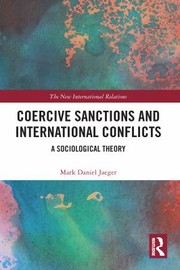
Coercive Sanctions and International Conflicts
Mark Daniel Jaeger · 2021
Where to buy
Amazon’s price changes daily, so the most accurate place to see it is there, at the moment you buy.
View on AmazonAbout the book
Perhaps the most common question raised in the literature on coercive international sanctions is: "Do sanctions work?" Unsurprisingly, the answer to such a sweeping question remains inconclusive. However, even the widely-presumed logic of coercive sanctions - that economic impact translates into effective political pressure - is not the primary driver of conflict developments. Furthermore, existing rationalist-economistic approaches neglect one of the most striking differences seen across sanctions conflicts: the occurrence of positive sanctions or their combination with negative sanctions, implicitly taking them as logically indifferent. Instead of asking whether sanctions work, this book addresses a more basic question: How do coercive international sanctions work, and more substantially, what are the social conditions within sanctions conflicts that are conducive to either cooperation or non-cooperation? Arguing that coercive sanctions and international conflicts are relational, socially-constructed facts, the author explores the (de-)escalation of sanctions conflicts from a sociological perspective. Whether sanctions are conducive to either cooperation or non-cooperation depends on the one hand on the meaning they acquire for opponents as inducing decisions upon mutual conflict. On the other hand, negative sanctions, positive sanctions, or their combination each contribute differently to the way in which opponents perceive conflict, and to its potential transformation. Thus, it is premature to ‘predict’ the political effectiveness of sanctions simply based on economic impact. --
Book details
- Year
- 2021
- Language
- English
- Publisher
- Taylor & Francis Group
- Editions
- 8
- Pages
- 254
- ISBN
- 9781032095479
Data source: Wikidata