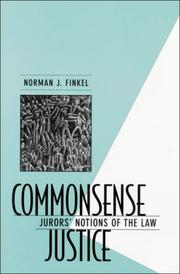
Commonsense Justice
Norman J. Finkel · 2001
Where to buy
Amazon’s price changes daily, so the most accurate place to see it is there, at the moment you buy.
View on AmazonThis is an affiliate link: if you buy through it, the site earns a small commission at no extra cost to you, which helps us bring quality content and maintain the site. As an Amazon Associate we earn from qualifying purchases.
About the book
In this timely book, Norman Finkel looks at the relationship between the "law on the books," as set down in the Constitution and developed in cases and decisions, and what he calls "commonsense justice," the ordinary citizen's notions of what is just and fair. Law is an essentially human endeavor, a collection of psychological theories about why people think feel, and behave as they do, and when and why we should find some of them blameworthy and punishable. But is it independent of community sentiment as some would contend? Or, as Finkel suggests, do juries bring the community's judgment to bear on the moral blameworthiness of the defendant? When jurors decide that the law is unfair, or the punishment inappropriate for a particular defendant, they have sometimes nullified the law. . Nullification represents the jury's desire not to defeat but "to perfect and complete" the law. It is the "no confidence" vote of commonsense justice refusing to follow the path the law has marked out - and pointing to new path based on what seem to be more just grounds. Finkel brings to life the story behind the jury and judicial decisions, interweaving anecdotes, case law, and social science research to present a balanced and comprehensive view of important legal and social policy issues.
Book details
- Year
- 2001
- Language
- English
- Publisher
- Harvard University Press
- Editions
- 4
- Pages
- 400
- ISBN
- 9780674005563
Data source: Wikidata
More by Norman J. Finkel