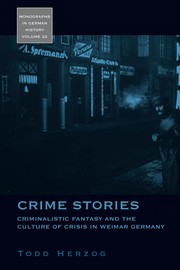
Crime stories
Todd Herzog · 2009
Where to buy
Amazon’s price changes daily, so the most accurate place to see it is there, at the moment you buy.
View on AmazonThis is an affiliate link: if you buy through it, the site earns a small commission at no extra cost to you, which helps us bring quality content and maintain the site. As an Amazon Associate we earn from qualifying purchases.
About the book
The Weimar Republic (1918{u2013}1933) was a crucial moment not only in German history but also in the history of both crime fiction and criminal science. This study approaches the period from a unique perspective - investigating the most notorious criminals of the time and the public{u2019}s reaction to their crimes. The author argues that the development of a new type of crime fiction during this period - which turned literary tradition on its head by focusing on the criminal and abandoning faith in the powers of the rational detective - is intricately related to new ways of understanding criminality among professionals in the fields of law, criminology, and police science. Considering Weimar Germany not only as a culture in crisis (the standard view in both popular and scholarly studies), but also as a culture of crisis, the author explores the ways in which crime and crisis became the foundation of the Republic{u2019}s self-definition. An interdisciplinary cultural studies project, this book insightfully combines history, sociology, literary studies, and film studies to investigate a topic that cuts across all of these disciplines.
Book details
- Year
- 2009
- Language
- English
- Series
- Monographs in German history -- v. 22
- Publisher
- Berghahn Books
- Editions
- 3
- Pages
- 182
- ISBN
- 9781845454395
Data source: Wikidata