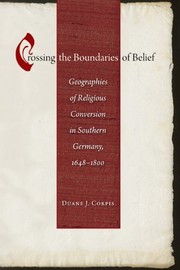
Crossing the Boundaries of Belief
Duane J. Corpis · 2014
Where to buy
Amazon’s price changes daily, so the most accurate place to see it is there, at the moment you buy.
View on AmazonAbout the book
In early modern Germany, religious conversion was a profoundly social and political phenomenon rather than purely an act of private conscience. Because social norms and legal requirements demanded that every subject declare membership in one of the state-sanctioned Christian churches, the act of religious conversion regularly tested the geographical and political boundaries separating Catholics and Protestants. In a period when church and state cooperated to impose religious conformity, regulate confessional difference, and promote moral and social order, the choice to convert was seen as a disruptive act of disobedience. Investigating the tensions inherent in the creation of religious communities and the fashioning of religious identities in Germany after the Thirty Years' War, Duane Corpis examines the complex social interactions, political implications, and cultural meanings of conversion in this moment of German history. In Crossing the Boundaries of Belief, Corpis assesses how conversion destabilized the rigid political, social, and cultural boundaries that separated one Christian faith from another and that normally tied individuals to their local communities of belief. Those who changed their faiths directly challenged the efforts of ecclesiastical and secular authorities to use religious orthodoxy as a tool of social discipline and control. In its examination of religious conversion, this study thus offers a unique opportunity to explore how women and men questioned and redefined their relationships to local institutions of power and authority, including the parish clergy, the city government, and the family.--
Book details
- Year
- 2014
- Language
- English
- Publisher
- University of Virginia Press
- Editions
- 4
- Pages
- 328
- ISBN
- 9780813935522
Data source: Wikidata