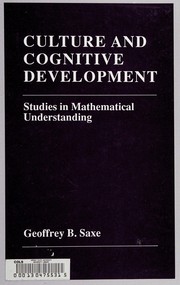
Cultural development of mathematical ideas
Geoffrey B. Saxe · 2012
Where to buy
Amazon’s price changes daily, so the most accurate place to see it is there, at the moment you buy.
View on AmazonAbout the book
"The book presents a general framework for the analysis of culture-cognition relations that makes use of field studies with a remote Papua New Guinea culture group, the Oksapmin, as an illustrative case"-- "Drawing upon field studies conducted in 1978, 1980, and 2001 with a remote Papua New Guinea group, the Oksapmin, Geoffrey Saxe traces the emergence of new forms of numerical representations and ideas in the social history of the community. In traditional life, the Oksapmin used a 27-body-part counting system, and there is no evidence that Oksapmin used arithmetic in prehistory. With shifting practices of economic exchange and schooling, children and adults unwittingly reproduce and alter the system as they solve new kinds of numerical and arithmetical problems, a process that leads to new forms of collective representations in the community. While Saxe,Ŵs focus is on the Oksapmin, the insights and general framework he provides are useful for understanding shifting representational forms and emerging cognitive functions in any human community"--
Book details
- Year
- 2012
- Language
- English
- Publisher
- Cambridge University Press
- Editions
- 8
- Pages
- 400
- ISBN
- 9781283610407
Data source: Wikidata
More by Geoffrey B. Saxe