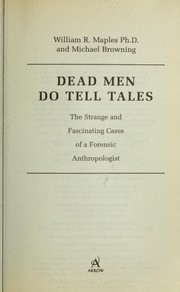
Dead men do tell tales
William R. Maples, Michael Browning · 1994
Where to buy
Amazon’s price changes daily, so the most accurate place to see it is there, at the moment you buy.
View on AmazonThis is an affiliate link: if you buy through it, the site earns a small commission at no extra cost to you, which helps us bring quality content and maintain the site. As an Amazon Associate we earn from qualifying purchases.
About the book
William Maples is blessed with an eerie but powerful gift. From a skeleton, a skull, a mere fragment of burnt thighbone, he can deduce the age, gender and ethnicity of a corpse, and the manner in which the victim was dispatched; his gift has sealed the doom of many a killer. His skill is to read the tales of death written on the bones of the dead, and in this fascinating book he revisits his strangest, most interesting and most horrific investigations, from gruesome and baffling dismemberment cases to the revelation of the identity of long-buried skeletons. In his work at the C.A. Pound Human Identification Laboratory at the University of Florida, Dr. Maples has borne witness to every act of cruelty and brutality of which the criminal mind is capable. Yet he never forgets that the remains spread before him were once human beings, and that compassion is as powerful a tool in solving the riddle of bones as is scientific knowledge. Maples has gained an international reputation for his work on skeletons ranging from the family of Czar Nicholas II to Vietnam MIAs to conquistador Francisco Pizarro, but, as he writes in these memoirs, his most satisfying moments come when his investigations lead to "the heavy clang and click of a prison door slamming shut" on the guilty. Dead Men Do Tell Tales is a completely engrossing journey into the world of forensic anthropology, the science of bones, a form of detection equal parts knowledge and empathy.
Book details
- Year
- 1994
- Language
- English
- Publisher
- Main Street Books
- Editions
- 2
- Pages
- 304
- ISBN
- 9780385479684
Data source: Wikidata
More by William R. Maples