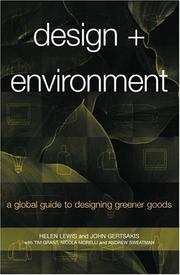
Design + Environment
Helen Lewis · 2017
Where to buy
Check today’s price on Amazon. We do not show prices because they change daily.
View on AmazonAffiliate link. As an Amazon Associate we earn from qualifying purchases.
About the book
"There is a huge scarcity of good, practical resources for designers and students interested in minimizing the environmental impacts of products. Design + Environment has been specifically written to address this paucity. The book first provides background information to help the reader understand how and why design for environment (DfE) has become so critical to design, with reference to some of the most influential writers, designers and companies in the field. Next, Design + Environment provides a step-by-step approach on how to approach DfE: to design a product that meets requirements for quality, cost, manufacturability and consumer appeal, while at the same time minimising environmental impacts. The first step in the process is to undertake an assessment of environmental impacts, using life-cycle assessment (LCA) or one of the many simpler tools available to help the designer. From then on, DfE becomes an integral part of the normal design process, including the development of concepts, design of prototypes, final design and development of marketing strategies. Environmental assessment tools and strategies to reduce environmental impacts, such as the selection of appropriate materials, are then discussed. Next, some of the links between environmental problems, such as global warming, ozone depletion, water and air pollution and the everyday products we consume are considered. In order to design products with minimal environmental impact, we need to have a basic understanding of these impacts and the interactions between them. The four subsequent chapters provide more detailed strategies and case studies for particular product groups: packaging, textiles, furniture, and electrical and electronic products. Guidelines are provided for each of the critical stages of a product's life, from the selection of raw materials through to strategies for recovery and recycling. Finally, Design + Environment takes a look at some of the emerging trends in DfE that are offering us the opportunity to make a more significant reduction in environmental impacts. Both the development of more sustainable materials and technologies and the growing interest in leasing rather than selling products are examined. Design + Environment is organized as a workbook rather than an academic text. It should be read once, and then used as a key reference source. This clear and informative book will prove to be invaluable to practising designers, to course directors and their students in
Book details
- Year
- 2017
- Language
- English
- Publisher
- Taylor & Francis Group
- Editions
- 2
- Pages
- 200
- ISBN
- 9781351282178
Data source: Wikidata
More by Helen Lewis