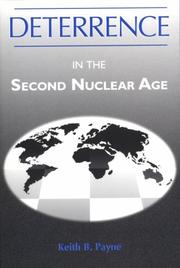
Deterrence in the second nuclear age
Keith B. Payne · 1996
Where to buy
Check today’s price on Amazon. We do not show prices because they change daily.
View on AmazonAffiliate link. As an Amazon Associate we earn from qualifying purchases.
About the book
Keith Payne begins by asking, "Did we really learn how to deter predictably and reliably during the Cold War?" He answers cautiously in the negative, pointing out that we know only that our policies toward the Soviet Union did not fail. What we can be more certain of, in Payne's view, is that such policies will almost assuredly fail in the Second Nuclear Age - a period in which direct nuclear threat between superpowers has been replaced by threats posed by regional "rogue" powers newly armed with chemical, biological, or nuclear weapons. The fundamental problem with deterrence theory is that it posits a rational, reasonable - hence predictable - opponent. History frequently demonstrates the opposite. Payne argues that as the one remaining superpower, the United States needs to be more flexible in its approaches to regional powers. No one model of deterrence can cover all contingencies, and in some cases deterrence theory simply may not apply. He reveals why, particularly in light of political reluctance to use nuclear weapons, U.S. power projection forces may be the mainstay of U.S. regional deterrence threats in the foreseeable future. Yet because conventional forces are likely to be inadequately "fearsome" to deter in some cases, the nuclear threat must not be moved completely into the background, else we could be deterred by those we seek to deter.
Book details
- Year
- 1996
- Language
- English
- Publisher
- University Press of Kentucky
- Editions
- 2
- Pages
- 184
- ISBN
- 9780813148434
Data source: Wikidata
More by Keith B. Payne