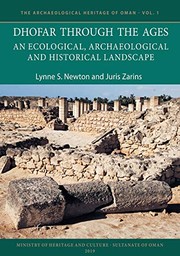
Dhofar Through the Ages
Lynne S. Newton, Juris Zarins · 2019
Where to buy
Amazon’s price changes daily, so the most accurate place to see it is there, at the moment you buy.
View on AmazonThis is an affiliate link: if you buy through it, the site earns a small commission at no extra cost to you, which helps us bring quality content and maintain the site. As an Amazon Associate we earn from qualifying purchases.
About the book
Dhofar, the southern governorate of Oman, lies within a distinctive ecological zone due to the summer Southwest Monsoon. It is home to numerous indigenous succulent plants, the most famous of which is frankincense (Boswellia sacra). The region, tied in the past to both Oman and Yemen, has a long and distinguished archaeological past stretching back to the Lower Paleolithic ca. 1.5 my BP. Dhofar is also home to a distinctive people, the Modern South Arabian Languages speakers (MSAL) since at least the last 15,000 years. Ancient Zafar (Al-Habudi), now called Al-Baleed, and its successor Salalah was and is the province's largest city. From the seventh century onwards until the arrival of the Portuguese in 1504 AD Al-Baleed dominated the central southern Arabian coastline politically and economically. Archaeological surveys and excavations in the governorate, beginning in 1954, have brought to light Dhofar's ancient past.
Book details
- Year
- 2019
- Language
- English
- Publisher
- Archaeopress Archaeology
- Editions
- 4
- Pages
- 148
- ISBN
- 9781789691603
Data source: Wikidata