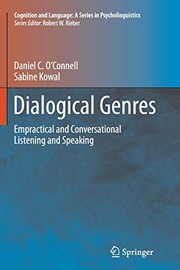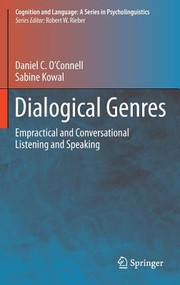
Dialogical Genres
Daniel C. O'Connell, Sabine Kowal · 2012
Where to buy
Amazon’s price changes daily, so the most accurate place to see it is there, at the moment you buy.
View on AmazonThis is an affiliate link: if you buy through it, the site earns a small commission at no extra cost to you, which helps us bring quality content and maintain the site. As an Amazon Associate we earn from qualifying purchases.
About the book
What happens in everyday dialogue? The authors revert to a rich prehistory to answer this question: Philipp Wegener in the late 19th and Karl Bühler in the first half of the 20th century in the German traditions of philology and psychology. Their work culminated in the concept empractical speech. This groundbreaking book opens up a new view of language use in settings in which participants are primarily involved not in speaking but in some non-linguistic activity and in which the need for speech arises only occasionally. Behold empractical speech, a genre unto itself with respect to conversation – an ubiquitous phenomenon of everyday life and the very setting of early language acquisition. The historical, theoretical, and empirical approaches of Dialogical Genres establish differences between empractical and conversational speech. The authors’ theoretical orientation is psychological.^ Their empirical methodology is quantitative and qualitative analysis of excerpts from feature films. Salient topics include: • A revisionist history of psycholinguistic. • Differences between empractical and conversational speech: more silence, fewer speaker changes, less syntactic structure. • Psychological principles of all spoken dialogue: intersubjectivity, perspectivity, open-endedness, verbal integrity. • Social responsibility of listeners and speakers. Psychologists and other social communication scientists will find Dialogical Genres rewarding and provocative. This precise and nuanced book explores and situates one of the core features of the life of speech– empractical speech – that has been shunted aside by late 20th century theorists; it continues the work of the great masters, especially Philipp Wegener and Karl Bühler.^ With supplementary and rich contemporary means it reconfigures our ways of viewing a whole dimension of the life of language and the speakers and listeners who animate it and are animated by it. O’Connell and Kowal have blended historical, theoretical, and empirical sides of their investigation into an elegant unity Robert E. Innis, Ph.D., University of Massachusetts Lowell, MA, USA This book gives back to situational context the primacy it had in Philipp Wegener’s and Karl Bühler’s theories of language and communication. The focus is on empractical speech --^ speech embedded in nonlinguistic activities. In this prototype of language use, language, action and context provide the threedimensional space of meaning-making. In this process the listen
Book details
- Year
- 2012
- Language
- English
- Publisher
- Springer
- Editions
- 1
- Pages
- 225
- ISBN
- 9781461435280
Data source: Wikidata