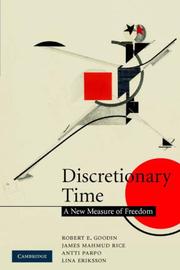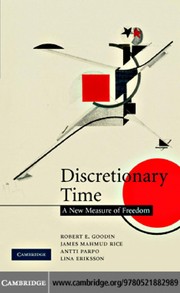
Discretionary time
Robert E. Goodin, Rice, James Mahmud, Parpo, Antti, Lina Eriksson · 2008
Where to buy
Amazon’s price changes daily, so the most accurate place to see it is there, at the moment you buy.
View on AmazonThis is an affiliate link: if you buy through it, the site earns a small commission at no extra cost to you, which helps us bring quality content and maintain the site. As an Amazon Associate we earn from qualifying purchases.
About the book
A healthy work-life balance has become increasingly important to people trying to cope with the pressures of contemporary society. This trend highlights the fallacy of assessing well-being in terms of finance alone; how much time we have matters just as much as how much money. The authors of this book have developed a novel way to measure 'discretionary time': time which is free to spend as one pleases. Exploring data from the US, Australia, Germany, France, Sweden and Finland, they show that temporal autonomy varies substantially across different countries and under different living conditions. By calibrating how much control people have over their time, and how much they could have under alternative welfare, gender or household arrangements, this book offers a new perspective for comparative cross-national enquiries into the temporal aspects of human welfare. • The first attempt to assess the impact of welfare states and gender regimes on people's daily lives • Analyses how much time people actually need to spend on things, and how much free time they have left • Systematically maps alternative ways of organizing households and assesses the impact different 'household rules' might have on the discretionary time of household members
Book details
- Year
- 2008
- Language
- English
- Publisher
- Cambridge University Press
- Editions
- 7
- Pages
- 488
- ISBN
- 9780521882989
Data source: Wikidata
More by Robert E. Goodin