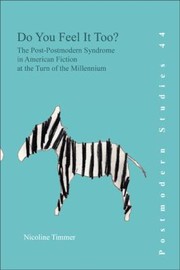
Do You Feel It Too
Nicoline Timmer · 2010
Where to buy
Amazon’s price changes daily, so the most accurate place to see it is there, at the moment you buy.
View on AmazonThis is an affiliate link: if you buy through it, the site earns a small commission at no extra cost to you, which helps us bring quality content and maintain the site. As an Amazon Associate we earn from qualifying purchases.
About the book
Do you feel iIt too? explores a new sense of self that is becoming manifest in experimental fiction written by a generation of authors who can be considered the 'heirs' of the postmodern tradition. It offers a precise, in-depth analysis of a new, post-postmodern direction in fiction writing, and highlights which aspects are most acute in the post-postmodern novel. Most notable is the emphatic expression of feelings and sentiments and a drive toward inter-subjective connection and communication. The self that is presented in these post-postmodern works of fiction can best be characterized as relational. To analyze this new sense of self, a new interpretational method is introduced that offers a sophisticated approach to fictional selves combining the insights of post-classical narratology and what is called 'narrative psychology'. Close analyses of three contemporary experimental texts - Infinite Jest (1996) by David Foster Wallace, A Heartbreaking Work of Staggering Genius (2000) by Dave Eggers, and House of Leaves (2000) by Mark Danielewski - provide insight into the typical problems that the self experiences in postmodern cultural contexts. Three such problems or 'symptoms' are singled out and analyzed in depth: an inability to choose because of a lack of decision - making tools; a difficulty to situate or appropriate feelings; and a structural need for a 'we' (a desire for connectivity and sociality). The critique that can be distilled from these texts, especially on the perceived solipsistic quality of postmodern experience worlds, runs parallel to developments in recent critical theory. These developments, in fiction and theory both, signal, in the wake of poststructural conceptions of subjectivity, a perhaps much awaited 'turn to the human' in our culture at large today.
Book details
- Year
- 2010
- Language
- English
- Publisher
- Rodopi
- Editions
- 1
- Pages
- 388
- ISBN
- 9789042029309
Data source: Wikidata