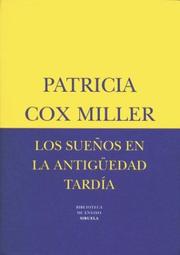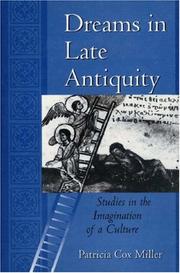
Dreams in late antiquity
Patricia Cox Miller · 1997
Where to buy
Amazon’s price changes daily, so the most accurate place to see it is there, at the moment you buy.
View on AmazonAbout the book
Dream interpretation was a prominent feature of the intellectual and imaginative world of late antiquity, for martyrs and magicians, philosophers and theologians, polytheists and monotheists alike. Finding it difficult to account for the prevalence of dream-divination, modern scholarship has often condemned it as a cultural weakness, a mass lapse into mere superstition. In this book, Patricia Cox Miller draws on pagan, Jewish, and Christian sources and modern semiotic theory to demonstrate the integral importance of dreams in late-antique thought and life. She argues that Graeco-Roman dream literature functioned as a language of signs that formed a personal and cultural pattern of imagination and gave tangible substance to ideas such as time, cosmic history, and the self. . Miller first discusses late-antique theories of dreaming, with emphasis on theological, philosophical, and hermeneutical methods of deciphering dreams as well as the practical uses of dreams, especially in magic and the cult of Asclepius. She then considers the cases of six Graeco-Roman dreamers: Hermas, Perpetua, Aelius Aristides, Jerome, Gregory of Nyssa, and Gregory of Nazianzus. Her detailed readings illuminate the ways in which dreams provided solutions to ethical and religious problems, allowed for the reconfiguration of gender and identity, provided occasions for the articulation of ethical ideas, and altogether served as a means of making sense and order of the world.
Book details
- Year
- 1997
- Language
- English
- Publisher
- Princeton University Press
- Editions
- 1
- Pages
- 286
- ISBN
- 9780691058351
Data source: Wikidata