DSP for MATLAB and LabVIEW
Forester W. Isen · 2009
Where to buy
Check today’s price on Amazon. We do not show prices because they change daily.
View on AmazonAffiliate link. As an Amazon Associate we earn from qualifying purchases.
About the book
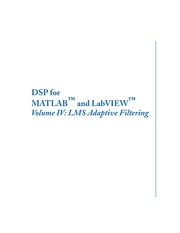
This book is Volume IV of the series DSP for MATLAB and LabVIEW. Volume IV is an introductory treatment of LMS Adaptive Filtering and applications, and covers cost functions, performance surfaces, coefficient perturbation to estimate the gradient, the LMS algorithm, response of the LMS algorithm to narrow-band signals, and various topologies such as ANC (Active Noise Cancelling) or system modeling, Noise Cancellation, Interference Cancellation, Echo Cancellation (with single- and dual-H topologies), and Inverse Filtering/Deconvolution. The entire series consists of four volumes that collectively cover basic digital signal processing in a practical and accessible manner, but which nonetheless include all essential foundation mathematics. As the series title implies, the scripts (of which there are more than 200) described in the text and supplied in code form (available via the internet at http://www.morganclaypool.com/page/isen) will run on both MATLAB and LabVIEW.^ The text for all volumes contains many examples, and many useful computational scripts, augmented by demonstration scripts and LabVIEW Virtual Instruments (VIs) that can be run to illustrate various signal processing concepts graphically on the user's computer screen. Volume I consists of four chapters that collectively set forth a brief overview of the field of digital signal processing, useful signals and concepts (including convolution, recursion, difference equations, LTI systems, etc), conversion from the continuous to discrete domain and back (i.e., analog-to-digital and digital-to-analog conversion), aliasing, the Nyquist rate, normalized frequency, sample rate conversion, and Mu-law compression, and signal processing principles including correlation, the correlation sequence, the Real DFT, correlation by convolution, matched filtering, simple FIR filters, and simple IIR filters.^ Chapter 4 of Volume I, in particular, provides an intuitive or "first principle" understanding of how digital filtering and frequency transforms work. Volume II provides detailed coverage of discrete frequency transforms, including a brief overview of common frequency transforms, both discrete and continuous, followed by detailed treatments of the Discrete Time Fourier Transform (DTFT), the z-Transform (including definition and properties, the inverse z-transform, frequency response via z-transform, and alternate filter realization topologies including Direct Form, Direct Form Transposed, Cascade Form, Parallel
Book details
- Year
- 2009
- Language
- English
- Series
- Synthesis lectures on signal processing -- # 7
- Publisher
- Morgan & Claypool Publishers
- Editions
- 1
- ISBN
- 9781598299007
Data source: Wikidata