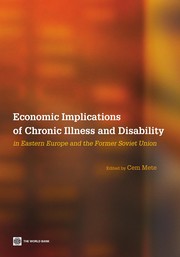
Economic implications of chronic illness and disability in Eastern Europe and the former Soviet Union
World Bank · 2008
Where to buy
Amazon’s price changes daily, so the most accurate place to see it is there, at the moment you buy.
View on AmazonAbout the book
This report aims to fill in the knowledge gap in this field by analyzing cross-country data on basic indicators, and by carrying out more detailed empirical analysis on causal relationships of interest, including the impact of disability on employment, wages, poverty, and children's school enrollments-focusing on four transition countries with household survey data sets that allow more elaborate econometric analyses. This report argues that it is timely to bring the economic costs of disability to the forefront of development policy because of the large impact poor health status and disabilities have on employment, poverty, children's schooling, and time spent in caring for disabled individuals, especially by adult females (which in turn inhibits higher female labor force participation prospectus). In recent years, there has been some recognition of the need to discuss disability issues in strategy documents such as poverty reduction strategy papers (PRSPs) and country assistance strategies (CASs). But in the absence of basic empirical evidence on the living conditions and behavior of disabled individuals, it is a challenge to formulate concrete steps to tackle this particular economic development problem.
Book details
- Year
- 2008
- Language
- English
- Publisher
- World Bank
- Editions
- 1
- Pages
- 136
- ISBN
- 9780821373378
Data source: Wikidata
More by World Bank