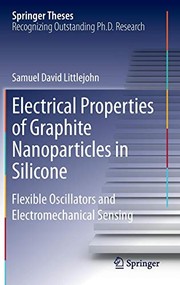
Electrical Properties of Graphite Nanoparticles in Silicone
Samuel David Littlejohn · 2013
Where to buy
Amazon’s price changes daily, so the most accurate place to see it is there, at the moment you buy.
View on AmazonAbout the book
This thesis examines a novel class of flexible electronic material with great potential for use in the construction of stretchable amplifiers and memory elements. Most remarkably the composite material produces spontaneous oscillations that increase in frequency when pressure is applied to it. In this way, the material mimics the excitatory response of pressure-sensing neurons in the human skin. The composites, formed of silicone and graphitic nanoparticles, were prepared in several allotropic forms and functionalized with naphthalene diimide molecules. A systematic study is presented of the negative differential resistance (NDR) region of the current-voltage curves, which is responsible for the material’s active properties. This study was conducted as a function of temperature, graphite filling fraction, scaling to reveal the break-up of the samples into electric field domains at the onset of the NDR region, and an electric-field induced metal-insulator transition in graphite nanoparticles. The effect of molecular functionalization on the miscibility threshold and the current-voltage curves is demonstrated. Room-temperature and low-temperature measurements were performed on these composite films under strains using a remote-controlled, custom-made step motor bench.
Book details
- Year
- 2013
- Language
- English
- Publisher
- Springer London, Limited
- Editions
- 2
- ISBN
- 9783319007410
Data source: Wikidata