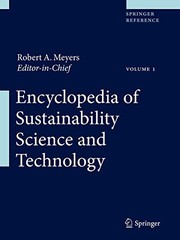
Encyclopedia of Sustainability Science and Technology
Robert A. Meyers · 2012
Where to buy
Amazon’s price changes daily, so the most accurate place to see it is there, at the moment you buy.
View on AmazonAbout the book
Sustainability in environmental usage refers to the potential longevity of vital human ecological support systems, such as the planet's climate system, systems of agriculture, industry, forestry, fisheries and the ocean, and fresh water, together with the impact of human communities, transportation systems, and the built environment in general on these natural services. Although definitions of “sustainable development” are often stated without reference to the number of people to be supported and at what standard of living, it is clear that we face something like a 50% increase in food demand as early as 2030, while global energy and materials use is expected to grow by 300% over this period. At the same time, the proportion of the population that lives in an urban environment will rise from about 47% to 60%. Up until now, economic development, growth, and sustainability strategies such as the “green revolution” were heavily dependent on large inputs of fossil fuels. In addition, about 70% of available freshwater is used by agriculture. Many of these approaches no longer appear sustainable as many natural resources, including petroleum, are poised to become scarce relative to population. Sustainability science and technology is not a discipline, but is the grand challenge of our time. Top-down approaches to controlling population growth, maintaining biodiversity, modeling large-scale systems, etc. certainly do exist, and perspectives on a number of these issues can be found in a complementary work, Springer’s “Encyclopedia of Complexity and Systems Science.” However, science and technology and the resulting innovation economy is also a bottom-up affair involving myriad individuals and research teams in publicly funded scientific laboratories and private corporations. This process of innovation is essentially unpredictable resulting in a great range of promising technologies that are individually dwarfed by the scope of the sustainability challenge but represent essential contributions to this goal. The Encyclopedia of Sustainability Science and Technology (ESST) is founded on this assumption. An indispensable resource for scientists and engineers in developing new technologies and for applying existing technologies to sustainability, ESST is presented at the university and professional level needed for scientists, engineers, and their students to support real progress in sustainability science and technology. Although the emphasis is on science and technol
Book details
- Year
- 2012
- Language
- English
- Publisher
- Springer New York
- Editions
- 7
- Pages
- 12555
- ISBN
- 9781441908520
Data source: Wikidata
More by Robert A. Meyers