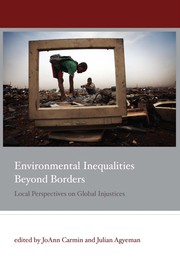
Environmental inequalities beyond borders
JoAnn Carmin · 2011
Where to buy
Amazon’s price changes daily, so the most accurate place to see it is there, at the moment you buy.
View on AmazonThis is an affiliate link: if you buy through it, the site earns a small commission at no extra cost to you, which helps us bring quality content and maintain the site. As an Amazon Associate we earn from qualifying purchases.
About the book
Multinational corporations often exploit natural resources or locate factories in poor countries far from the demand for the products and profits that result. Developed countries also routinely dump hazardous materials and produce greenhouse gas emissions that have a disproportionate impact on developing countries. This book investigates how these and other globalized practices exact high social and environmental costs as poor, local communities are forced to cope with depleted resources, pollution, health problems, and social and cultural disruption. Case studies drawn from Africa, Asia, the Pacific Rim, and Latin America critically assess how diverse types of global inequalities play out on local terrains. These range from an assessment of the pros and cons of foreign investment in Fiji to an account of the work of transnational activists combating toxic waste disposal in Mozambique. Taken together, the chapters demonstrate the spatial disconnect between global consumption and production on the one hand and local environmental quality and human rights on the other. The result is a rich perspective not only on the ways industries, governments, and consumption patterns may further entrench existing inequalities but also on how emerging networks and movements can foster institutional change and promote social equality and environmental justice.
Book details
- Year
- 2011
- Language
- English
- Series
- Urban and industrial environments
- Publisher
- MIT Press
- Editions
- 5
- Pages
- 256
- ISBN
- 9780262015516
Data source: Wikidata