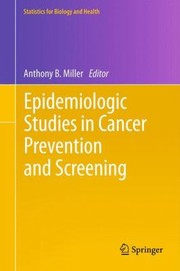
Epidemiologic Studies In Cancer Prevention And Screening
Anthony B. Miller · 2012
Where to buy
Amazon’s price changes daily, so the most accurate place to see it is there, at the moment you buy.
View on AmazonAbout the book
Epidemiologic Studies in Cancer Prevention and Screening is the first comprehensive overview of the evidence base for both cancer prevention and screening. This book is directed to the many professionals in government, academia, public health and health care who need up to date information on the potential for reducing the impact of cancer, including physicians, nurses, epidemiologists, and research scientists. The main aim of the book is to provide a realistic appraisal of the evidence for both cancer prevention and cancer screening. In addition, the book provides an accounting of the extent programs based on available knowledge have impacted populations. It does this through: 1. Presentation of a rigorous and realistic evaluation of the evidence for population-based interventions in prevention of and screening for cancer, with particular relevance to those believed to be applicable now, or on the cusp of application 2. Evaluation of the relative contributions of prevention and screening 3. Discussion of how, within the health systems with which the authors are familiar, prevention and screening for cancer can be enhanced. Overview of the evidence base for cancer prevention and screening, as demonstrated in Epidemiologic Studies in Cancer Prevention and Screening, is critically important given current debates within the scientific community. Of the five components of cancer control, prevention, early detection (including screening) treatment, rehabilitation and palliative care, prevention is regarded as the most important. Yet the knowledge available to prevent many cancers is incomplete, and even if we know the main causal factors for a cancer, we often lack the understanding to put this knowledge into effect. Further, with the long natural history of most cancers, it could take many years to make an appreciable impact upon the incidence of the cancer. Because of these facts, many have come to believe that screening has the most potential for reduction of the burden of cancer. Yet, through trying to apply the knowledge gained on screening for cancer, the scientific community has recognized that screening can have major disadvantages and achieve little at substantial cost. This reduces the resources that are potentially available both for prevention and for treatment.
Book details
- Year
- 2012
- Language
- English
- Publisher
- Springer London, Limited
- Editions
- 5
- ISBN
- 9781461455868
Data source: Wikidata