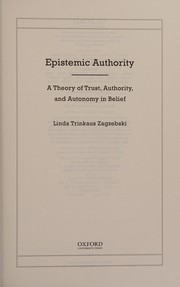
Epistemic authority
Linda Trinkaus Zagzebski · 2012
Where to buy
Amazon’s price changes daily, so the most accurate place to see it is there, at the moment you buy.
View on AmazonThis is an affiliate link: if you buy through it, the site earns a small commission at no extra cost to you, which helps us bring quality content and maintain the site. As an Amazon Associate we earn from qualifying purchases.
About the book
Gives an extended argument for epistemic authority from the implications of reflective self-consciousness. Epistemic authority is compatible with autonomy, but epistemic self-reliance is incoherent. The book argues that epistemic and emotional self-trust are rational and inescapable, that consistent self-trust commits us to trust in others, and that among those we are committed to trusting are some whom we ought to treat as epistemic authorities, modelled on the well-known principles of authority of Joseph Raz. Some of these authorities can be in the moral and religious domains. The book investigates the way the problem of disagreement between communities or between the self and others is a conflict within self-trust, and argue against communal self-reliance on the same grounds as the book uses in arguing against individual self-reliance. The book explains how any change in belief is justified--by the conscientious judgment that the change will survive future conscientious self-reflection. The book concludes with an account of autonomy. --Publisher's description.
Book details
- Year
- 2012
- Language
- English
- Publisher
- Oxford University Press
- Editions
- 1
- Pages
- 279
- ISBN
- 9780199936472
Data source: Wikidata
More by Linda Trinkaus Zagzebski